
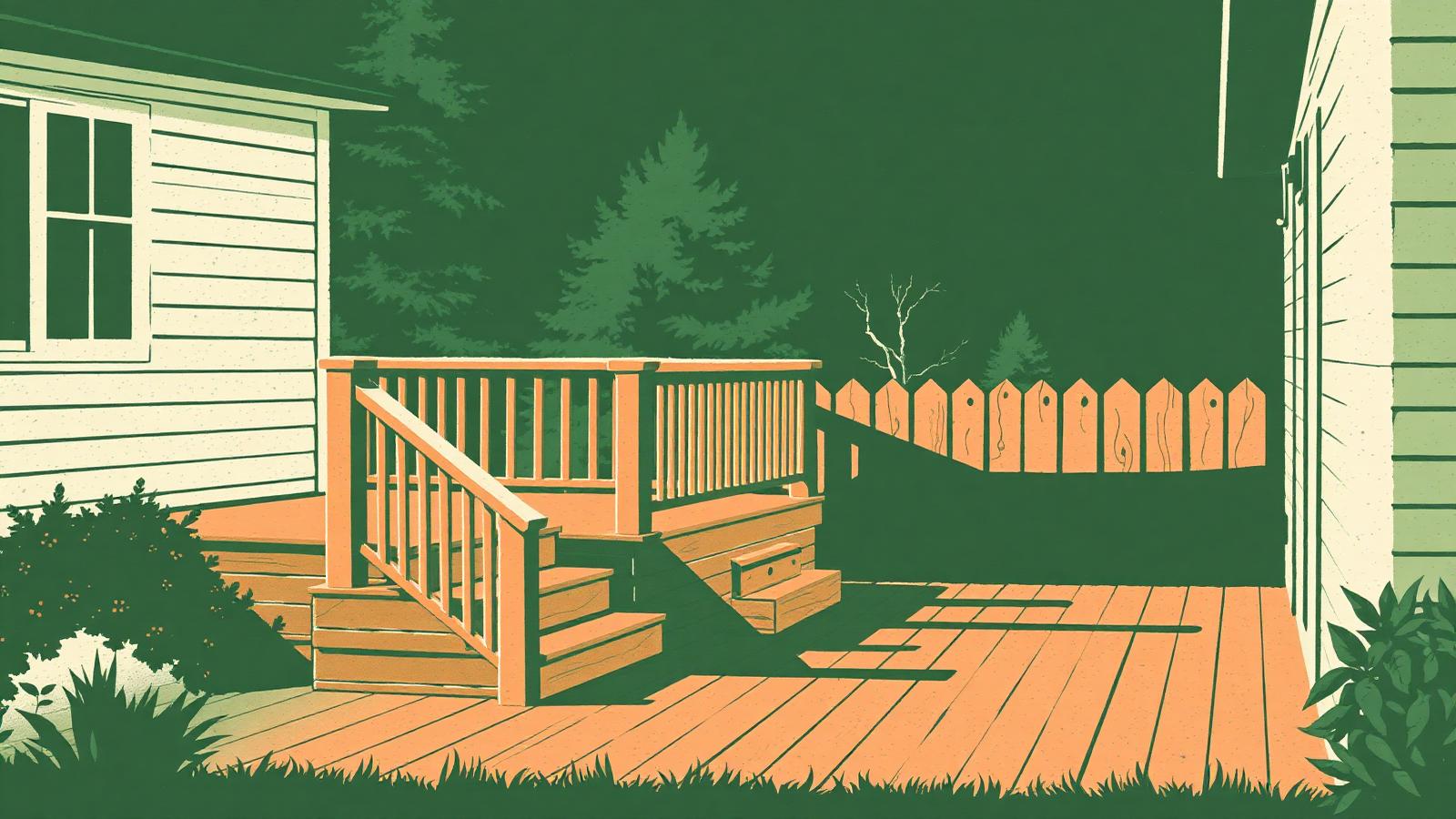
Why decks deserve real attention in a Calgary inspection
Decks are the part of the house that gets built with the most enthusiasm and the least documentation. A large share of Calgary decks were added by previous owners, sometimes without a permit, often with materials chosen at the lumber yard rather than by span table.
They also fail in a specific way: quietly and then all at once. A deck holds twenty people at a summer party in the year before its ledger lets go. Because deck collapses concentrate load and drop people from height, this is one of the few exterior items where an inspection finding is genuinely a safety finding rather than a maintenance note.
The ledger: the single most important connection
Where a deck attaches to the house, the ledger board carries roughly half the deck's load into the building. Two things go wrong. First, attachment: nails instead of properly sized lag screws or through-bolts, fasteners into sheathing rather than rim joist, or attachment into a brick or stucco veneer that was never structural.
Second, water. A ledger tight against the wall without flashing collects water at the exact place where framing meets framing. Rot develops behind the board where nobody sees it until the deck sags. During inspection, the ledger area is examined where accessible: visible fastener type and pattern, flashing presence, gaps, staining, siding condition above, and movement or deflection when the deck is walked.
Where the ledger connection is fully concealed and the deck shows deflection or age, the correct outcome is a recommendation for further evaluation — not a guess.
Guards, spacing and stairs
Guard requirements exist because falls from decks are common and injuries are real. Inspectors look at whether a guard is present where the walking surface is meaningfully above grade, whether the guard height appears adequate, whether the infill spacing is tight enough to prevent a small child passing through, and whether the design invites climbing with horizontal members that act like a ladder.
Stairs get the same scrutiny: consistent rise and run, secure stringers, proper landing at the bottom, and a graspable handrail on flights of more than a couple of risers. Uneven rise on a deck stair is one of the most common trip findings in Calgary backyards, especially where a bottom step lands on soil that has settled.
A home inspection reports observed conditions against general safety expectations. It is not a code-compliance certification, and municipal requirements change over time — a deck built legally in 1996 may not match today's standard and is not automatically defective.
Footings, frost depth and the deck that moves
Calgary's frost depth means footings must extend below the frost line to avoid heaving. Decks on shallow precast blocks set on grade are common and they move — usually visible as a deck that has pulled away from the house, stairs that no longer line up with the landing, or a guard that leans further each year.
Footings are almost never visible during inspection. What is visible is the evidence: gaps at the ledger, out-of-level framing, sloped decking, racking, cracked joints and stairs separating from the deck edge. Those symptoms get documented and, where movement is significant, referred for further evaluation.
Rot, fasteners and the maintenance clock
Rot in a Calgary deck starts in predictable places: cut end grain that never got sealed, posts in direct ground contact, the tops of joists under decking where water sits against the fastener, stair stringers at the bottom cut, and anywhere planters or mats hold moisture against the surface.
Fasteners matter too. Pressure-treated lumber and older uncoated fasteners react; corroded nails and screws lose capacity long before the wood does. Inspectors probe accessible areas where appropriate and document soft wood, staining, corrosion, missing joist hangers and hangers fastened with the wrong nails.
Composite decking removes surface rot but not structural rot — the frame underneath is still wood and still ages.
Fences, retaining walls and property lines
Fences rarely change a purchase decision, but two related items can. First, retaining walls: a leaning or bulging wall over about a metre in height can be a substantial repair and, in some cases, an engineering matter. Second, encroachment: a fence built off the property line is a survey and legal question, not an inspection question.
Where a fence or wall shows lean, rot at the ground line, failed posts or drainage backing up behind it, the report documents it and points the buyer to the appropriate specialist or a Real Property Report review.
